Casino History in Ho Chi Minh City Through Screen Images
Casino history in Ho Chi Minh City gains context through a close reading of screen images, with a clear method for separating film convention from local history.
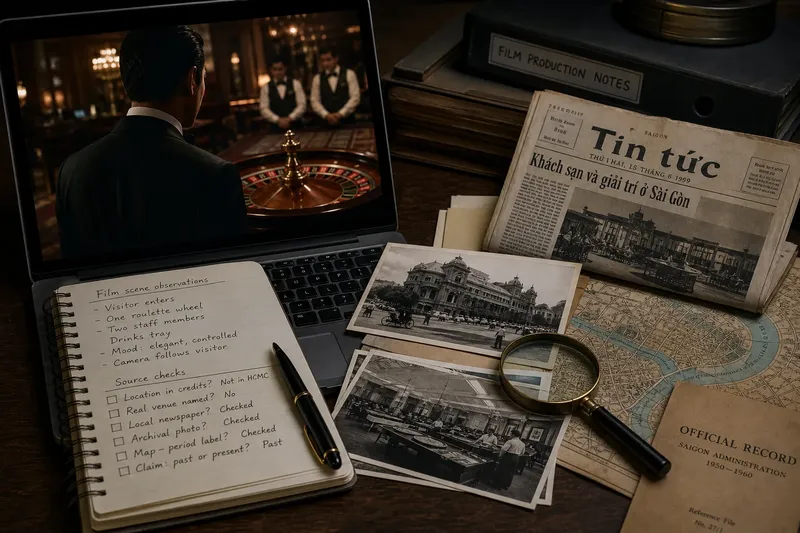
A viewer pauses a film as a roulette wheel glows behind a sharply dressed character. That image can prompt a question about casino history in Ho Chi Minh City, but it cannot answer it by itself: to understand the city’s past, screen conventions must be read alongside dated, local sources.
Screen history and evidence
A casino scene is evidence of a film’s choices: its sets, costumes, camera angles and ideas about risk or status. It becomes evidence about a real place only when its production context and location are established, and even then the image records a designed scene rather than a complete account of local life.
For a historical claim about Ho Chi Minh City, identify the source, date and place behind it. A film credit may help establish where a scene was made; contemporary newspapers, archival photographs, maps and official records can provide other kinds of context. Each source has limits, so a claim should not exceed what the material shows.
Write down what the source establishes before interpreting its mood.
Reading film periods
Screen conventions change, but period labels alone cannot explain why. Compare named films and their release dates rather than assuming that every older film presents glamour and every newer one presents danger. Look at the scene’s purpose in its own story, the production design and the historical context available for that work.
A useful comparison tracks the same details across films: who is shown, which parts of the room receive attention, how staff appear, and whether the game’s rules matter to the plot. This can reveal shifts in cinematic emphasis without turning a handful of scenes into a claim about all films or about Ho Chi Minh City’s venues.
Compare specific scenes, not broad eras in isolation.
Local historical context
Ho Chi Minh City has its own urban and entertainment history; a studio set or an unidentified casino interior cannot stand in for it. To connect a screen image to the city, look for a verified location or production record, then consult local material that addresses the relevant time and subject.
Keep the questions distinct. A film can show how its makers imagined casino culture; a dated local record may help establish what existed in the city; current venue information concerns present-day services, not the past. This distinction makes the argument more specific and prevents a familiar cinematic image from being mistaken for local documentation.
Questions about screen history?
Can a film establish a venue’s history?
Only if reliable production or location evidence connects the scene to that venue, and the film still shows a selected, staged moment. For claims about the venue’s history, seek independent records that support the particular detail.
What should I compare between films?
Note the release date, setting, camera focus, treatment of staff and guests, and the role of game rules in the plot. Those observations support a comparison of screen conventions, not a general claim about every casino or period.
Where can I check a local historical claim?
Start with dated material tied to Ho Chi Minh City, such as archival photographs, newspapers, maps or official records, and record who created it and what it actually states. If sources conflict or the claim matters for publication, consult a qualified local historian or archivist.
Does a realistic-looking set make a scene documentary?
No. Careful lighting, furnishings and costume can make an invented room feel credible while leaving its location and historical accuracy unestablished.
A worked reading
Imagine an invented film scene: a visitor enters a room with one roulette wheel, two uniformed staff members and a drinks tray. The viewer writes these starting observations in a notebook, then checks the film’s credits and production notes for a location. Suppose those materials name no casino in Ho Chi Minh City; the viewer records the room as a designed setting, not a local venue.
Next, the viewer reviews one dated local newspaper clipping and one archival photograph chosen for the same historical question. If neither mentions or depicts the film’s room, the decision is to keep the film as evidence of screen design and use the local sources only for the details they establish. If a production record instead identifies a local location, the viewer can investigate that connection while still treating the scene’s action as staged.
The result is a bounded claim: the fictional scene presents access, service and gaming as part of its story, while the checked sources do not establish that this room existed in the city. The distinction is useful because it preserves what the film can tell us without asking it to do the work of an archive.
Practical source checks
- Check whether the scene names a real venue; if it does, verify the name in an independent dated source, and if it does not, describe the setting as unidentified.
- Check the film credits for a location; if they identify Ho Chi Minh City, seek corroboration, and if they do not, avoid assigning the scene to the city.
- Check the date and creator of a photograph; if both are documented, cite its limited visual evidence, and if either is unknown, do not use it to date a venue.
- Check whether a newspaper clipping reports a specific event or merely advertises a service; if it reports an event, attribute the claim to the report, and if it is promotional, treat it as an advertisement.
- Check whether a map labels the place and period at issue; if it does, compare that label with other records, and if it does not, use it only for the features it shows.
- Check whether the claim concerns past history or current services; if it concerns the past, use dated historical material, and if it concerns the present, consult current venue information instead.
Point of view matters
A camera can make a guest’s decision seem central while leaving staff work, ordinary procedures and people outside the room unseen. A film that follows a worker or a less privileged visitor may give the same décor a different meaning. That shift reveals whose experience the story chooses to make legible.
For casino history in Ho Chi Minh City, the soundest reading keeps the screen and the archive in conversation without confusing their roles. A film can show how casino culture was imagined; local, dated sources are needed to support claims about the city itself.