How to Read Casino Floor Signs in Ho Chi Minh City
Casino floor signs in Ho Chi Minh City can make a venue easier to navigate: learn to read destination labels, map symbols and route boundaries before setting off.
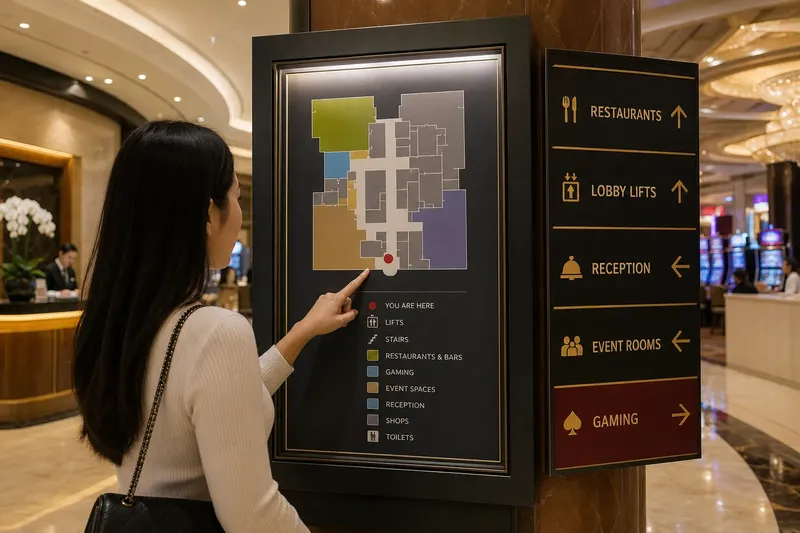
You step into a hotel lobby in Ho Chi Minh City and see arrows for dining, lifts and a casino-style entertainment area. Casino floor signs can help you trace the building’s layout without treating every corridor as part of the same space.
Destination labels
Signs often name places by function: restaurant, bar, reception, event room or gaming area. Read the full label rather than relying on a familiar word such as “lounge”, which may refer to a particular venue rather than a general seating area.
In a large hotel complex, a sign may point to a destination several turns away. Match its wording with the directory at the next junction, especially where arrows split towards different wings.
Follow the destination name, not just the nearest arrow.
Maps and symbols
A directory map can show your current position, lift lobbies, stairs and named zones. Find the “you are here” mark first, then trace the route to the place you want to reach. Symbols are useful, but their meaning can vary, so check the map legend rather than guessing.
Colour-coded paths can help distinguish routes, but printed labels and arrows provide a clearer cross-check. If a colour is difficult to see or appears on several routes, use the words and map symbols instead.
At a lift lobby, compare the directory’s destination name with the sign beside the lift before choosing a floor.
Boundaries and corridors
A corridor beside a gaming area may serve a different destination or end at a controlled doorway. A barrier, checkpoint or notice limiting entry marks a boundary; it is not a cue to look for a shortcut through the space.
Stay on the route marked for your destination. If signs point into a restricted area or give conflicting directions, pause in the public part of the building and ask reception or venue staff to identify the correct route.
Use the last clear public sign as your reference point when a corridor becomes confusing.
How should you interpret floor signs?
What does “you are here” mean?
It marks your position on a directory map, not necessarily the entrance to the place you are seeking. Use it to orient the map, then follow the route and destination labels from that point.
What if two signs use different names?
Do not assume the names refer to the same room or service. Compare them with the directory, and ask staff to clarify if the route remains uncertain.
Can colour alone identify a route?
Colour can reinforce a route, but it may be hard to distinguish or used differently across the building. Check the printed destination and symbols as well.
What should you do at a barrier?
Treat a barrier or checkpoint as a boundary and do not pass through it to reach another destination. Return to the last public junction and ask staff for an appropriate route.
Six route checks
- Destination name: If the arrow names your intended place, follow it; if the name differs, check the directory before turning.
- Map position: If the “you are here” mark matches your location, trace the displayed route; if it does not, find another directory or ask staff to orient you.
- Floor label: If the lift directory and destination sign show the same floor, use that lift route; if they conflict, pause and confirm the floor with reception.
- Route symbol: If the map legend identifies the symbol you need, follow it alongside the written label; if the symbol is unexplained, rely on named destinations or ask staff.
- Boundary marker: If the corridor is clearly open and marked for your destination, continue; if there is a barrier or checkpoint, turn back to the public junction and request another route.
- Colour-coded path: If the colour and printed destination agree, use them together; if they conflict or the colour is unclear, follow the wording and check the directory.
A route through the lobby
Imagine you enter a hotel lobby intending to reach a restaurant. Your starting point is the public entrance; the directory lists “Garden Dining” on an upper floor, while a separate arrow points towards gaming. You locate the lobby mark, trace the route to “Garden Dining”, and compare that name with the lift directory. If the names match, you take the public lift and follow the dining signs; if they do not, you ask reception before choosing a corridor. The observable result is a route decision based on matching labels, rather than a guess based on the gaming arrow.
When directions conflict
A printed directory, a sign at a junction and a temporary notice may point in different directions. Treat a clear barrier or boundary notice as the point not to cross, then ask venue staff to reconcile the route information.
For casino floor signs in Ho Chi Minh City, the most useful habit is to match the destination wording at each junction and stop when the route no longer agrees. That small pause can keep a simple trip to dinner or reception on the public path.