Reading Ho Chi Minh City Through a Casino Story
Read a casino story set in Ho Chi Minh City with sharper attention to street scenes, hotel interiors and the way a venue frames its place in the city.
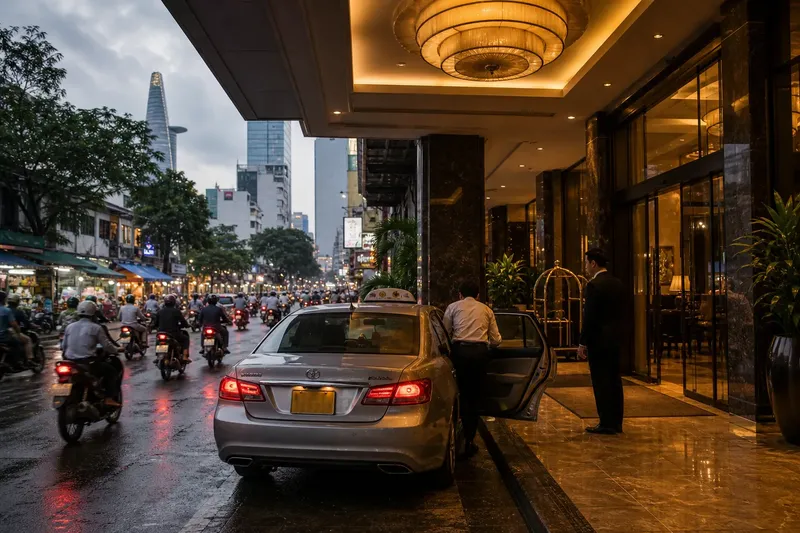
A taxi turns off a crowded Ho Chi Minh City street and pauses beneath a hotel canopy; scooters continue past as the doors close behind the passenger. In a casino story, that small transition can show how the writer sets an enclosed venue against the city’s visible, audible street life.
Reading a casino story set in Ho Chi Minh City is partly a matter of following its point of view. The useful question is not only what a venue is called, but which parts of the city the story lets the reader see—and which remain outside the frame.
Follow the setting
A city name gives a story a broad location, not a complete picture of its surroundings. A named neighbourhood, a street-facing entrance or a description of traffic from a hotel lobby can anchor a scene more clearly than a passing reference to Ho Chi Minh City.
Notice what the writer selects: food stalls beyond the entrance, a taxi at the kerb, or a quiet room set back from the street. These details create a particular contrast, but they do not stand for every district or neighbourhood.
Keep the scene’s location as specific—or as broad—as the account allows.
Read the city contrast
Casino-style entertainment stories often place a controlled interior beside a busy street. The contrast may come through sound, movement, lighting or a threshold such as a lobby door. It can help explain the story’s mood without making a claim about the whole city.
Ask what changes at the boundary. If traffic noise fades as a narrator enters a lounge, the text establishes a shift in sound. If the account then moves directly to a gaming area, it may be changing scenes rather than describing a route through the building.
A city scene is strongest when you can identify the detail that creates its contrast.
Separate venue settings
A hotel, restaurant, lounge and gaming area may appear in the same account, but each setting has its own role. A story might use the lobby to establish arrival, a restaurant to suggest hospitality and a gaming area to signal the venue’s entertainment focus.
Track the writer’s verbs. “Entered” describes a movement into a space; “mentioned” simply names it. “Later ate” gives a dining scene, while “was shown” leaves open how the narrator encountered the room. Those distinctions reveal how the story is assembled, not what every visitor can expect.
For each setting, note whether it is shown as part of an event or included as background.
Notice the language
Descriptions such as “welcoming”, “lively” or “refined” express a point of view. They may come from a narrator, a venue description or another source, and the wording matters because each voice frames the place differently.
Pair an evaluation with the concrete detail nearby. A host pointing towards a lift is an action; calling the welcome warm is an interpretation. Keeping both in view helps a reader understand the tone without treating one person’s description as universal.
Attribute a strong impression to the voice that gives it.
Read a passage closely
Use these checks to distinguish city texture from claims about a venue. Each observation leads to a decision about how narrowly to read the passage.
- Location: If the passage names a street or neighbourhood, record that place; if it names only Ho Chi Minh City, keep the setting broad and do not assign a district.
- Street detail: If it describes traffic, shopfronts or food stalls, treat those as details of the scene; if it gives no street-level detail, do not fill in the surroundings.
- Movement: If the narrator says they entered or crossed between spaces, record that stated movement; if the text jumps between rooms, treat them as separate scenes and do not invent a route.
- Hospitality: If a meal or host interaction appears in a described scene, record that event; if booking or access is not addressed, leave those practical questions open.
- Venue language: If the account calls a space “lively” or “refined”, attribute that judgement to its speaker; if it also describes a specific action, keep the action distinct from the evaluation.
- City contrast: If the passage contrasts a busy street with a quiet interior, read it as the writer’s chosen contrast; if no wider context appears, do not generalise it to the city as a whole.
What does a city scene show?
Does a hotel scene represent Ho Chi Minh City?
It shows one setting in the city, often an interior with a controlled view of the street. Look for neighbourhood or street details before reading it as a broader portrait.
How should I read polished venue language?
Identify who uses the description and what concrete scene accompanies it. Treat broad praise as that speaker’s perspective, rather than as a description of every visit.
What does a transition between spaces tell me?
A stated transition connects the spaces in the order the writer describes. If a lobby and gaming area are merely named, the passage does not establish that the narrator moved between them.
Can a story explain visitor arrangements?
It can describe an arrangement, but the account may apply only to the setting and moment it depicts. If a practical decision depends on current details, check with an appropriate, up-to-date source.
Work through a scene
Say you are reading an invented passage that starts with a taxi arriving at a hotel on an unnamed Ho Chi Minh City street. The narrator hears traffic fade in the lobby, speaks briefly with a host, and later names a gaming area and restaurant without describing either visit. The starting details are one unnamed street, one lobby arrival, one host conversation and two named but undescribed spaces.
First, record the location as a hotel on an unnamed city street; the result is a city-level setting, not a neighbourhood. Next, mark the fading traffic as a sound contrast and the host conversation as one described interaction. Finally, classify the gaming area and restaurant as two mentions rather than completed stops. The resulting reading is specific: the passage shows an arrival and a change in sound, while leaving the narrator’s experience of the other spaces unstated.
When reading a casino story set in Ho Chi Minh City, pay attention to the boundary between street and interior. That boundary can reveal the writer’s chosen perspective while leaving the city larger than the venue on the page.